
FRAME wanted to create an experience that shows how a product fits clearly, visually, and in context, removing the friction of shopping for the perfect fit online. Already partnered with Domaine, FRAME challenged us to rethink how detailed sizing and specifications could live on the Product Display Page (PDP) in a way that felt premium, intuitive, and scalable across a complex catalog.
Where Fit Falls Apart
Most fashion sites handle fit in one of three ways: a generic size chart, a short block of “true to size” copy, or leveraging the model’s size as a reference. This approach is common because it’s easy to implement and easy to maintain, but it pushes more work onto the customer. A shopper has to translate abstract measurements into something physical, compare it to items they already own, and decide whether the unknown is worth it.
Denim creates a particularly unique challenge in this space, as most shoppers find sizes vary from store to store. What constitutes a 34inch waist in one store, may translate to a 32inch waist in another store. Plus with varying styles of denim, from high-waist wide length to ankle grazer mom jean, each fit will look different depending on the customer.
When fit information is presented in a vague way, it often creates two outcomes that are hard on customers and brands. Some customers pause and leave because they can’t get comfortable with the decision and would prefer to try on in store, and others buy anyway and hope for the best, which can turn into disappointment, exchanges, or returns when expectations don’t match reality.
FRAME treated this gap as a brand opportunity. If fit is part of what makes their product premium, then fit guidance should feel premium too — clear, visual, and integrated into the product page in a way that helps customers decide quickly without turning the PDP into a spreadsheet.
A Size Guide Cut for the Customer
Instead of adding more content to the product page, together with Domaine, FRAME focused on when fit information should appear. Shoppers don’t need sizing details all the time, but when they do, they need them immediately, clearly, and in context.
The solution was a custom flyout on the PDP, triggered by purposeful CTAs like “View fit details” or “See size guide.” Rather than sending customers away from the page or forcing them to scan a static chart, the flyout opens as a focused layer that keeps the shopper anchored in the product experience.
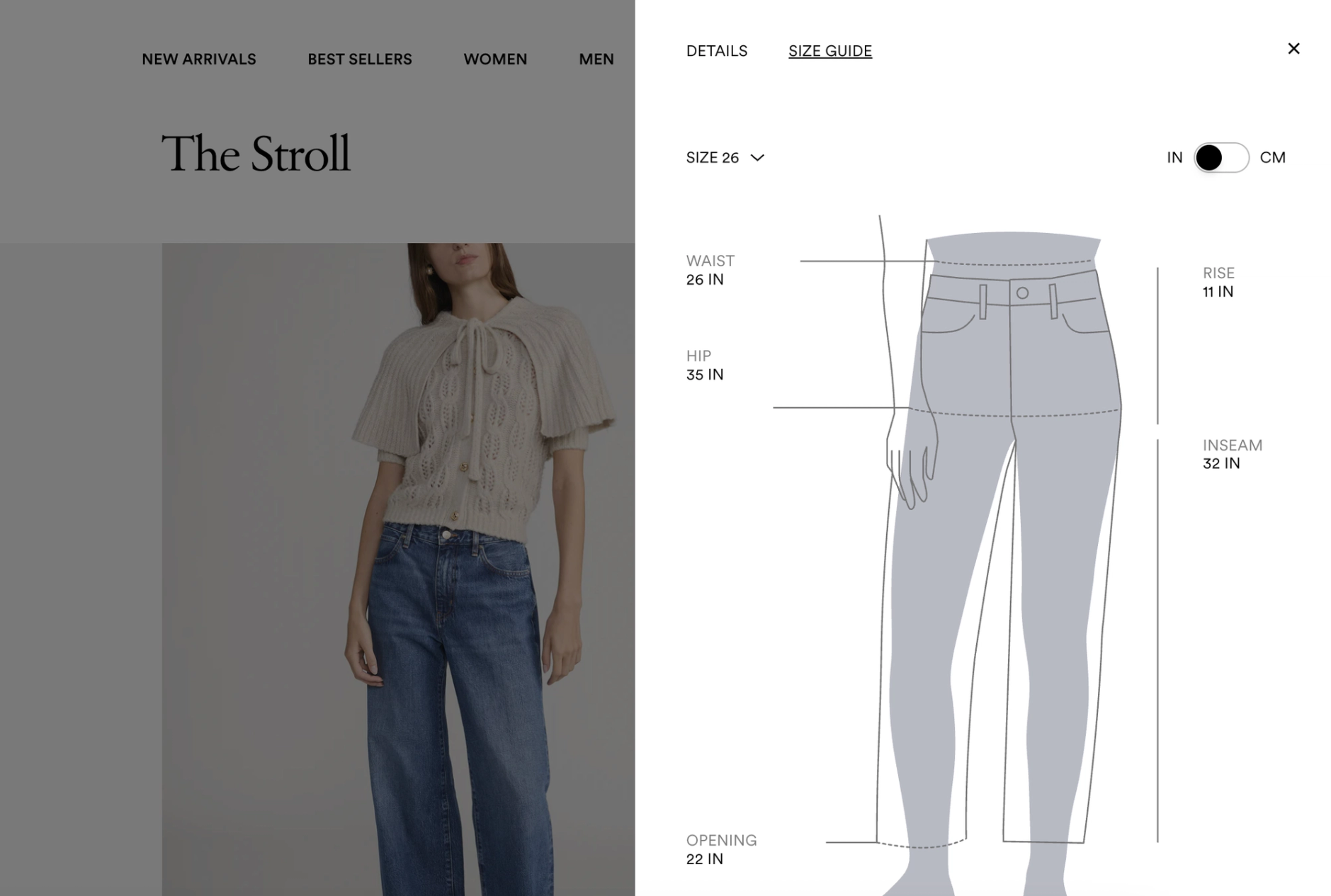
What appears inside that layer changes depending on the product. For denim, shoppers see an illustrated view of the jeans with clearly labeled measurements, inseam, rise, leg opening, presented in a way that mirrors how people actually think about fit. As sizes change, those measurements update accordingly, removing guesswork and helping customers understand how one size differs from the next. Footwear and tops surface entirely different information, tailored to what matters most for those categories.
By designing fit as an on-demand experience rather than a permanent fixture, FRAME keeps the PDP clean and editorial while still offering depth where it counts.
Tailoring the Back-End
Fit is not a single attribute; it’s a system of measurements that changes by product type, silhouette, and construction. Jeans don’t size like shoes, shoes don’t size like tops and treating them as interchangeable inevitably leads to compromise.
For FRAME, the challenge was to support product-specific sizing logic without creating one-off solutions that would be difficult to maintain over time. While sizing information already lived in a shared, centralized structure, the way it was organised made it harder to extend cleanly as the catalog evolved. Previous approaches relied on bespoke setups and fragmented metafields that were hard to extend and even harder to manage as the catalog evolved. The experience could look polished on the surface, but the structure underneath made iteration slow and brittle.
The solution was to treat fit as a data architecture problem first. Using Shopify metaobjects, Domaine refined and formalised the existing sizing data into structured, reusable schemas aligned to product type. This made the system easier to update, expand, and reason about without duplicating content or logic. And each product, like denim, footwear and tops, all follow a different schema, as of course, it’s not a one-product-fits-all approach.
This approach shifts fit from something hard-coded into templates to something the platform understands natively. It gives the brand a system they can grow with, rather than a workaround they have to protect. And critically, it allows the front-end experience to stay precise and flexible while the back-end remains clean, scalable, and manageable by the FRAME team inside Shopify.
The Runway to Success
Fit is one of the few areas in fashion ecommerce where clarity directly benefits everyone involved. Customers feel more confident making a purchase. Brands spend less time resolving uncertainty after the fact and, returns become more predictable and more preventable.
What FRAME’s approach demonstrates is that fit communication doesn’t have to be generic, overwhelming, or disconnected from the product experience. When sizing and specifications are presented visually, in context, and supported by the right underlying data, they become a meaningful part of how customers evaluate and trust a product.
If this is a challenge your team is facing, our experts would love to help you explore what’s possible just as we did with FRAME.


